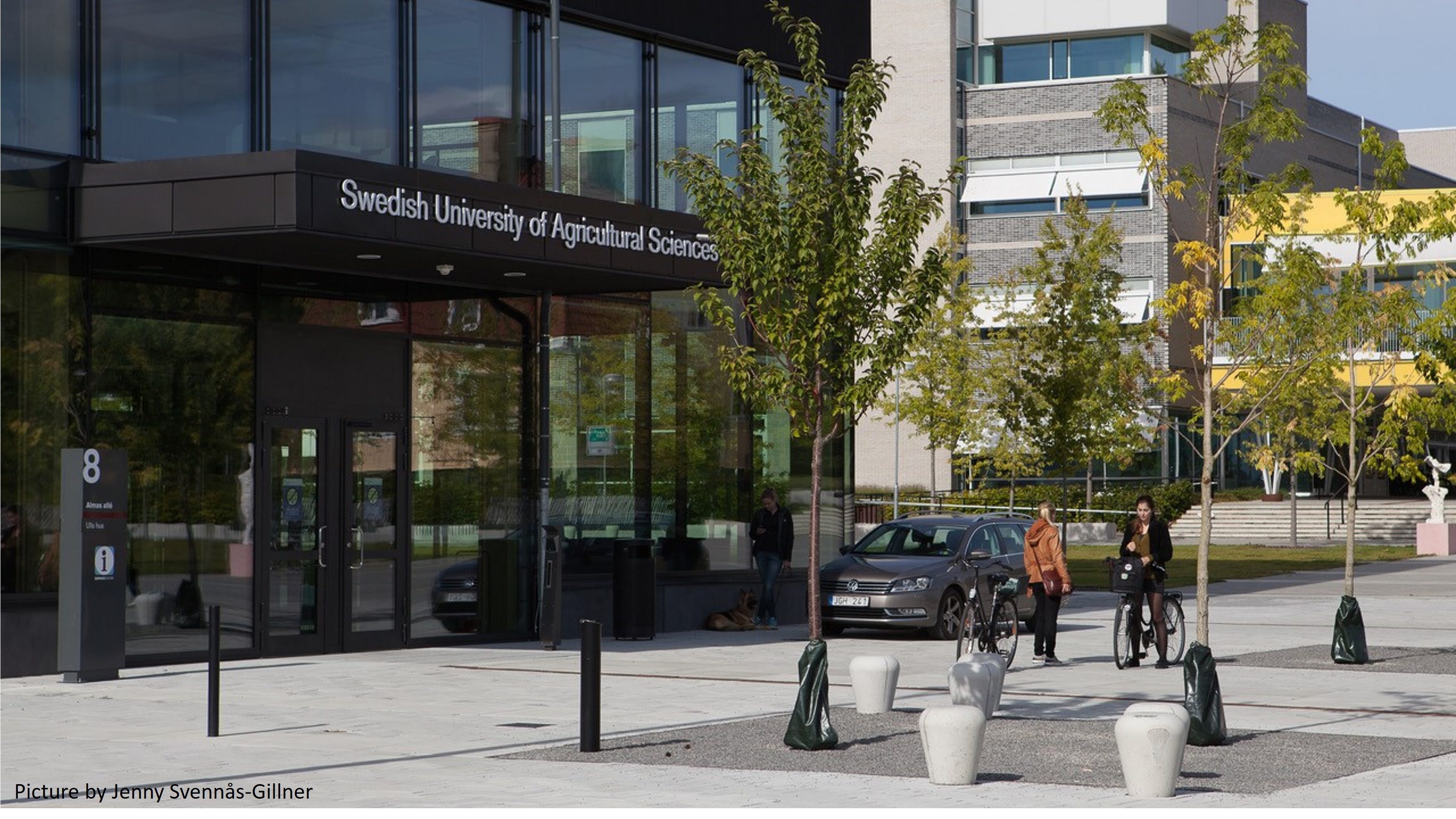
With the aim of increasing knowledge and network building around the Baltic Sea, we are now hosting a workshop in Uppsala, Sweden, for everyone interested in N-cycling related questions and issues.
We will have keynote speakers, oral presentations, group and panel discussions, poster mingle, as well as shared breaks and a conference dinner, so that we can interact and build new bridges.
Confirmed keynote speakers are:
Christian Lønborg (Aarhus University)
Dissolved organic nitrogen (DON) – an important nitrogen source and sink in coastal waters
In coastal waters, a dominant part of the dissolved nitrogen pool is found as dissolved organic nitrogen (DON). Despite its large pool size and importance, the difficulties involved in measuring the production and degradation pathways of DON have led to its often-overlooked role as an active component in biogeochemical cycles. In this presentation we aim to highlight the vital role of DON as a nutrient source and sink. Drawing on studies from around the globe, we will demonstrate that DON is not only an active but also a central component of the nitrogen cycle in coastal waters. Furthermore, we will emphasize the necessity of including DON in future studies of biogeochemical cycles in the Baltic Sea. Authors: Christian Lønborg & Cátia Carreira (University of Aveiro, Portugal)
Mark McCarthy (Estonian University of Life Sciences)
Internal nitrogen loading in aquatic systems: moving beyond nutrient concentration measurements and Liebig’s Law?
Aquatic systems impacted by anthropogenic eutrophication are often monitored intensively for evidence and mitigation of nutrient-related impacts, such as hypoxia and harmful algal blooms. ‘Snapshot’ nutrient concentration monitoring is common practice, but the most bioavailable nutrient forms (e.g., ammonium and reactive phosphorus) cycle and recycle rapidly, limiting the usefulness of discrete, static concentration measurements. Nutrient ‘limitation’ of primary productivity is dynamic in time and space, and the concept, based on Liebig’s Law, is often insufficient to explain controls on, for example, cyanobacteria growth and toxin production. Heterocyte differentiation and nitrogen fixation in cyanobacteria are energetically costly and may require extreme nitrogen stress to be initiated and completed on a cellular level. For ammonium, and nitrogen in general, the result in many freshwater studies is underappreciation of its importance due to low in situ concentrations, while marine-focused studies are more likely to consider these factors. Understanding internal nitrogen dynamics and its importance in contributing to eutrophication and cyanobacterial blooms requires quantification of rates at which various nitrogen forms are assimilated, recycled, and ultimately removed. In many large lakes, for example, internal nitrogen loading (e.g., ammonium regeneration, nitrogen fixation, sediment release, etc.), driven by external nitrogen loading, help support cyanobacterial blooms and N-rich toxin production, especially when non-nitrogen-fixing taxa dominate. This internal nitrogen loading helps explain how these taxa thrive despite high denitrification rates and low in situ concentrations. As the limnological community catches up to their marine colleagues and more fully understands the importance of nitrogen in driving eutrophication and contemporary (non-N-fixing, N-rich toxin-producing) cyanobacteria blooms, resource regulators and managers are increasingly calling for much needed control of external nitrogen loading, in addition to existing controls on phosphorus loading.
Elin Almroth Rosell (Swedish Meteorological and Hydrological Institute)
Ocean and coastal modelling in the Baltic Sea
Numerical models in the marine environment can be used in several ways, depending on its spatial and temporal resolution. They can be used to increase understanding of specific small and large processes as well as “what-if-scenarios” with the aim to improve the marine management. At SMHI we have several marine models with different resolutions to be used for different purposes. We have a 3-dimensional model covering the Baltic Sea and the North Sea simulating the physics of the ocean as well as the biogeochemistry, NEMO-SCOBI, used for hindcasts and future climate projections. We have the Swedish Coastal zone Model, SCM, that is a 1-dimensional model for each water body along the Swedish coast. All water bodies are connected via sounds and therefore cover the entire coast with both physics and biogeochemistry of the coastal zone. We also have a very high resolution model (50 m) in some specific areas of the Swedish coast, including the physics of the ocean.
In this presentation the models will be briefly described with some examples of the research and model developments that have been performed, that is on-going and briefly what is planned to be done.
Lora Harris (University of Maryland)
Paradigms of nitrogen cycling between Chesapeake Bay and the Baltic Sea
The impacts of eutrophication in both the Chesapeake Bay and Baltic Sea have focused our attention on the role and fate of excess nitrogen inputs. Each system’s response to a particular nitrogen load is a function of ecosystem size, structure, and the processes that influence rates of nitrogen cycling and use. This talk considers the differing paradigms of nitrogen cycling in each system against a backdrop of scale (residence times, depths, size) and the relative use and recycling of nitrogen in terms of concepts of efficiency and power. Comparing our mental models illuminates relative differences in how we understand the biogeochemical factors that influence nitrogen load impacts in each system.
The workshop is free of charge for all participants, please register via this link.
Please register as soon as possible, as seats may fill up quickly (registration ends 28.4.2025). A limited travel support is available upon request.
Looking forward to seeing you soon in Uppsala!
 BSNCN
BSNCN 